Showing posts with label variants - general. Show all posts

Monday, 20 January 2025

The Krosnogord 1944 campaign - Hypothetical


July 1944, while fighting in southern Poland, Soviet forces have come up against a mountain range, where the German positions on the high ground dominate the ground below, bringing accurate artillery fire onto anything that moves. Looking for a way to break through, 1st Brigade  have been ordered to advance into a mountain pass. Their objective is to probe west and take the town of Krosnogord at the far end of the valley. To reach it, they will have to cross the River Wislok, which could be well defended. If they can push beyond Krosnogord, the break through will be complete.

I will be using the tactical WWII boardgame, Old School Tactical published by Flying Pig and designed by Shayne Logan, to fight the various actions, but with a figures system to manage the campaign.

The final chapter in Charles Grant’s book ‘Programmed Wargame Scenarios’ (2nd Edition) has a generic campaign called Reconnaissance in Strength and essentially works as a ‘ladder’ campaign.

It is actually a reconnaissance in strength type scenario that deals with an advance along a mountain pass / valley by the Blue Force (Soviets for us), which will fight over eight game tables, before reaching the final table - the town. We shall replace the individual tables with the small maps that come with the boardgame’s various support modules.

Red Force (Germans for us) is defending the main town at the end of the pass, but they also have detachments further forwards in the valley, with the intent of delaying and disrupting Blue Force.

I will run this campaign with a series of short After Action Reports, so that the reader can follow the progress from map to map. All reports will be added to the campaign folder on my COMMANDERS site (link below). It will probably be played over several weeks or months and will be posted in chronological order.

The order that the paper maps will appear in the chain of advance will be chosen randomly. The final map is fixed and will be map number 1 from the ‘Phantom Division’ module, as this has concrete type building structures that will represent Krosnogord.

There are various mechanics in Grant’s book that will be used in the background to manage the campaign. Red Force can be ordered by the system and accordingly although I am handling both sides in each battle, for the German forces, the programmed system will be used as I sort of ‘Game Master’ things along. 

The record will be written mostly from the perspective of the Soviet attacker, so that the reader gets a vague idea as to the German player’s intentions and strengths, which are only revealed as the campaign unfolds.

The order-of-battle here reflects ownership of mainly 1st Edition OST Vol I upgraded to 2nd edition (east front) and the Red Blitz module, hence there is something of a hodge podge collection of unit types in the Soviet Infantry battalion, with companies of standard rifle sections, Irregulars and Guards, which is an unrealistic mix at this formation level, however, the game’s counter mix is what it is and those variables should give the Soviet player some interesting choices as to which troop types should be used at any one time and place. Just think of them as green or veteran etc.

Here are your available forces ……….. Captain Voronin

Soviet Order-of-Battle

Commander of 1st Brigade - Captain Voronin (You the player)

1st Infantry Battalion

Captain Sokolov

1st Company

Lt. Grenko

9 Rifle sections, 1 sergeant, 2 LMG, 1 Molotov, 1 ATR

2nd Company

Lt. Balakin

1 x Commissar

9 Guards Rifle sections, 1 sergeant, 2 LMG, 1 Molotov, 1 ATR

3rd Company

Lt. Aliyev

9 Irregular rifle sections, 1 sergeant, 2 LMG, 1 Molotov, 1 ATR

Heavy Weapons Company, 2 HMG, 2 x 57mm A/T guns with 2 trucks to tow

1st Tank Battalion (understrength)

Lt. Ivashin

1st Company - 10 x T34 / 76

2nd Company - 4 x T34 / 85

3rd Company (attached) - 5 x JSII

1st SMG Company (attached) 7 Shock sections, 1 Lt. Chekov, 1 sergeant, 3 satchel charges,

Reconnaissance Company 1 x Lt (spare), 2 BA-10 armoured cars, 3 trucks, 3 x 1st line rifle sections, 3 x sapper sections, 2 LMG 1 Sgt 1  flamethrower (sapper only)

Artillery support is randomly determined at the start of each battle.

All Gut Check ratings are 7 with the following exceptions.

Guards and Pioneers are 6, while Irregulars are 8.

Impulse Points - For each battle, the Soviet army gets a basic 4D6. After the first battle, this is always modified. At the conclusion of each battle, check how many casualty points the force lost during that battle. If it has been 12 or more then in future battles the Impulse allowance is permanently reduced by 2 points. These are cumulative modifiers, so if the Soviets have taken 12 or more casualties in two battles, their Impulse allowance for the fifth battle would be permanently lowered to 3D6 +2. Note in the final battle, regardless of any loss, Soviet Impulse Points are always returned to the full 4D6.

LINK TO COMMANDERS

https://commanders.simdif.com/krosnogord_campaign_1944.html

Friday, 10 December 2021

The Attack on Henry’s Hill - 1861

Yikes - flag fixed, thank's Alan


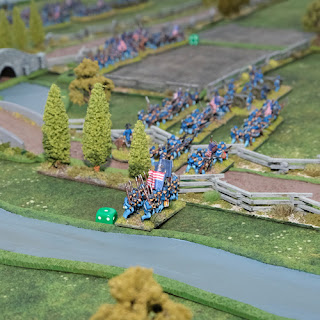
This is a boardgame and figure game mash-up adding activation chits to the Black Powder figure rules for random unit selection, breaking up the normal sequence of play. 


A few evenings ago, we played a boardgame on 1st Bull Run. Just as the Union were putting in their first attack against Confederate forces on and around Henry’s Hill, I took a few photographs and have now translated that moment into a figures game, using Black Powder rules and 12mm Kallistra figures. 


Our short boardgame session did not see us get very far into the game, but we felt that the Union were getting the best of it, as Confederate forces started taking heavy casualties. This Friday, we are gaming at my place, so I am putting this on as a figure game this time, to have another opportunity to examine that action.


This post looks at the scenario building, followed by a brief outline of a test game that I have played in preparation of our game session.


Please use the ‘read more’ tab for the rest of this post.  

Sunday, 29 August 2021

The Steelworks - ASL meets OST


The post is based around a 3rd party game module designed for ASL, I will be using the rather nice map, but tackling it with the counters and rules from another game system …. OST.

Advanced Squad Leader (ASL) is a WWII tactical boardgame published by Multi-Man Publications (MMP). Old School Tactical (OST) also covers WWII tactical at a similar scale and is published by Flying Pig Games.

The Steelworks, Colombelles, France, is a historically based ASL module published by Lone Canuck Publishing, who produce quality 3rd party material for the ASL system. 

As a generalisation, a noticeable difference between the two systems is that ASL is far more detailed and it has a larger and more established order-of-battle as it has been around for many more years, whilst OST has shorter rules that are easier to assimilate. Both have their fans and this article is in no way suggesting that one system is better than the other, it is just a case of playing with the kit that I have and hoping to enjoy another product that I took a shine to.

There is a link at the foot of the post in the ‘Resource Section’ of a replay of a Stalingrad scenario, which describes the ebb and flow of OST play. There is also a link to an ASL Starter Kit replay post which does similar for that system.

Please use the ‘read more’ tab for the rest of this post.

Monday, 25 March 2019

5th Edition Retro - Simplified tactical WWII gaming

Retro is written by Gary Graber and produced by his company, Minden Games. The latest Edition (5th edition published 2016) is available on Amazon.


In essence, the system is a variant, working best with the ASL boardgame, but adaptable with some conversion work, to other WWII tactical boardgames. The roots of the game come from a time when Gary and a co-worker wanted to play a Squad Leader type of game at work, but they didn’t really get much face-to-face opportunity, so Gary set about producing something that would allow one player to take a turn of the Squad Leader boardgame on their own and leave the board set up in the staff room. At some point the other player could then take their turn, when next in the staff room and so on.


To do this, he created a new sequence of play, significantly streamlined play and brought in some clever mechanics that aided non-face to face play. The consequential reduction in complexity of the original game, drew a fan base looking for an easier way to play their tactical games.

I bought 2nd Edition in 2001 and did a ton of games with it, including adapting it to fit Critical Hit’s 'Combat' system (later becoming ATS) and Panzer Grenadier from Avalanche Press (a platoon based game), but mainly went on to use it with ASL.


A lot has changed on the tactical game scene since 2001. Not least MMP, the owners of ASL have introduced a series of starter kits that make access into the ASL a lot easier, plus these days there is a greater range of choice of newer systems for the tactical gamer and a goodly proportion has been deliberately designed around lower complexity and accessibility.


Today, this makes Retro sit in a different place to my mind than it did all those years ago, but my affection for the rules and an admiration of their clever application of process and the hours of gaming pleasure they have given me remain, so I have replaced my 4th edition with the 5th edition and thought that this was a good time to write a ‘re-visiting’ article on the rules, of what made them different and of using them today.


Please Use the ‘Read More’ tab for the rest of this post.


Saturday, 23 February 2019

Converting a tabletop game to a boardgame

This post runs off last weeks post (see Resource Section below), in which I AAR’d an ACW game using 12mm figures on Hexon terrain. Actually starting with a hex based scenario meant that  moving the whole thing to a physical boardgame is fairly straight forward, though not without some practical hurdles, not least time and effort.


This post briefly outlines the process, costs and some things to embrace or avoid etc, plus there are a few photo’s of the replay action.


Please use the ‘read more’ tab for the rest of this post.

Saturday, 8 October 2016

Musket and Saber rules with ACW figures

Having recently been playing a few of the Musket and Saber mini-folio boardgames from Decision Games and with the rules fresh in my head, I thought it worth experimenting by taking the rule system to the miniatures tabletop using Kallistra 4" hexes and their 12mm ACW forces.


The following post looks at a generic scenario to test the rules and some observational notes on how it all worked out. 

Please press the 'read more' tab for the rest of this post.

Saturday, 4 June 2016

Battle generator for WWII games

L'nL Battle Generator with my own rules.

A few weeks ago I posted a review of Lock 'n Load's new Battlefield Generator for their recently released Russian module (Heroes of the Motherland) boardgame. As part of the review, a scenario was generated, which gave a compact one mapper game with relatively few forces.

The scenario worked out quite well, so I have used it as a basis of putting a miniatures game together using Kallistra 4" hexes and Pendraken 10mm figures.

This post gives an overview of the resulting 'mash-up'.

Please press the 'read more' tab for the rest of this post.

Sunday, 26 July 2015

Hexing 1 Hour Wargames ACW

One Hour Wargames by Neil Thomas offers simplified rules for wargaming in nine different periods. They are very stable and it is therefore relatively easy to bolt on house rules.


This post offers a 2 page ammendment sheet that primarily allows the game to be played on hexes, but which also takes the opportunity to introduce some Command and Control, Morale and Line of Sight rules.

These have been kept simple to stay within the design ethos of Mr. Thomas.

Please press the 'read more' tab for the rest of this post

Sunday, 3 May 2015

Eagles at Quatre Bras

This post covers the first few play tests of a new set of rules that I am working on with a view to getting some napoleonic games onto a hex grid within a relatively small gaming area. There are examples of both boardgame and figure game battle boards.


The units represent brigades and divisional artillery and the rules are set at the lower end of the complexity spectrum. Play is solitaire friendly and fits into an evening game session.

To read the rest of this post, please tap on the 'Read More' tab.

Sunday, 1 September 2013

Generic WWII tactical scenario for Retro

Scenario Z: Defiant Stand

This is a generic scenario that I put together a few years ago for the Retro variant from Minden Games. The idea is that it can be played with most tactical WWII systems with relatively little tinkering. It should be able to work with most nationalities. I don't normally ask for comments, but I would like to hear from anyone as to what system they used it with and how it worked out, as I have another scenario lined up that involves 'hitting the beaches' and the feedback would be helpful.


Retro 4th edition is a variant set of rules that can be used with different types of
tactical game designs. While the terminology used makes it ASL friendly, with varying
adjustments, I have used it with four other tactical systems.

Sunday, 23 June 2013

Hexes with rules for miniatures (Napoleonic).


This AAR is based around a marriage of two different games. I used the boardgame parts from GMT’s Commands & Colors Napoleonics, but used the rule system described by Neil Thomas in his book Napoleonic Wargaming, published by The History Press, as a way of exploring how to get the figure format into a smaller space.


160 page paperback, contains simple rules and army lists.


This is a self contained boardgame with board, terrain, rules, scenarios 
and French, British and Portuguese forces. Other nationalities are already available.