Showing posts with label 1 Hour Wargames. Show all posts

Thursday, 18 April 2024

One Hour Wargames in 1809


Having got my 1809 project to a point where a six unit French force and a four unit Austrian force now sit fully painted in their respective barracks, I have been enjoying pushing them around the table to the beat of some Neil Thomas scenarios.


His One Hour Wargames book has 30 generic scenarios and a variety of 2-3 page rule sets covering various major periods. Taken together, it ensures that whatever your interest, you only need small forces and a 3x3 space to get a game going.


With the units I have to date, I can do 10 of the 30 scenarios and due to their generic nature, I can treat all of them all as 1809 Danube actions.


For a table, I am using a 4x4 space rather than 3x3, simply because I prefer to avoid the visual distraction of marking the three foot boundaries off.


For rules, I shall use my own home brew set, as I continue to develop them through repeat play. By chance, my rules allow infantry in line to move 8”, while OHW have a movement rate of 6” so that pretty much softens the table growing from a 3x3 to a 4x4.


Anyway here are a few shots from some of the gaming situations falling from Danube fighting that I have enjoyed over recent days.


Scenario 30 - Last Stand.

A veteran and hardened formation from Red Army (Austrians) is acting as rearguard to their routing army. They have established themselves on the far side of a river with two crossing points. Can they make a respectable Last Stand against the attentions of Blue Army (French)?
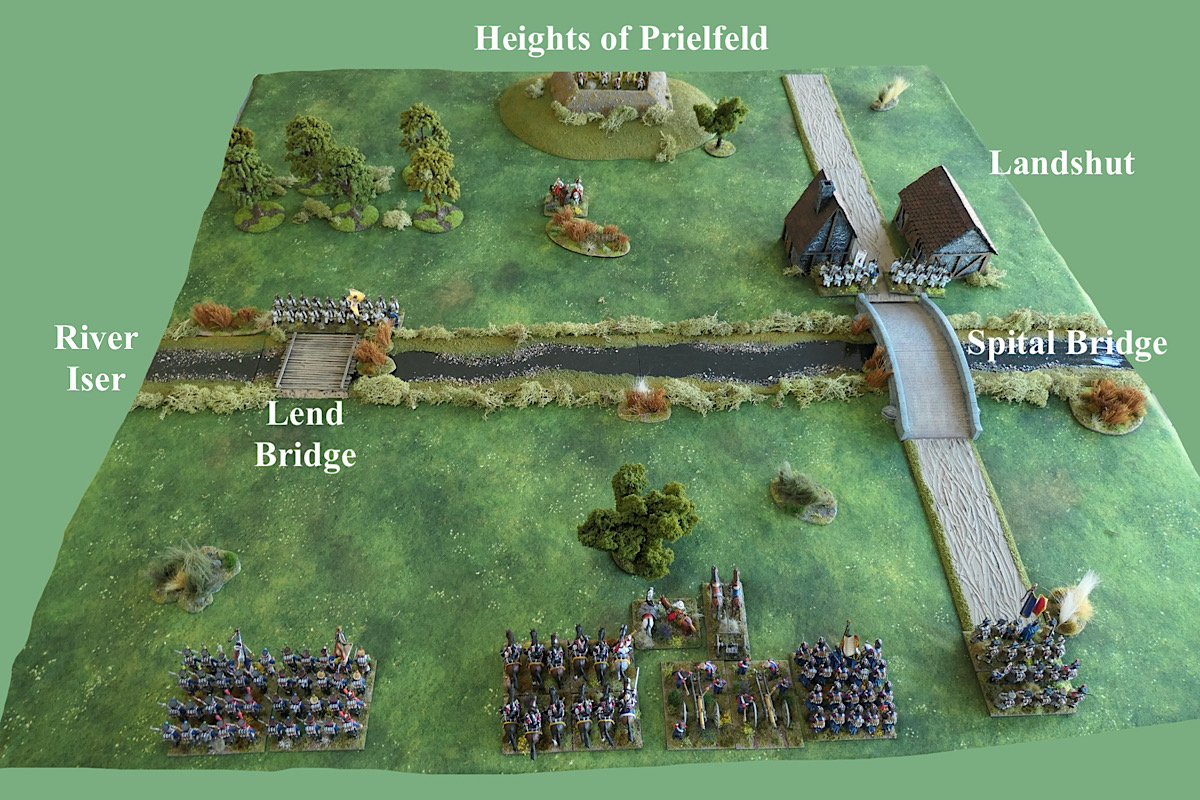


There is an interesting action described in Osprey’s Eggmühl 1809 (storm over Barvaria) book on pages 47 - 50, which coincides very closely with our Last Stand scenario and terrain set-up, even with artillery batteries up on the heights and two bridges and a town, so I took the liberty of transposing those place names and unit designations onto this table, it just added a bit of extra character to what was a generic scenario.


I rather liked the back and forth at the village as it passed hands several times. You often read about this sort of thing in accounts, but it is generally harder to do in war-games as time scales and units burning out often only allow an attack and perhaps one counter-attack, not much more.


In the end, the French took the village from the exhausted Austrians. At the same time, at the Lend Bridge, the French, after high losses took the bridge and cleared the way ahead. French heavy cavalry then poured over the bridge, moving across to the village, to chase the remnants of Austrian infantry from the field.


In the last moments of battle, French infantry in columns, assaulted the redoubt on the hill twice and twice their assault withered in the face of canister fire from the Austrian guns. The Austrian Last Stand had held on ….. just, literally on the last die roll!


Scenario 27 - Disordered Defence.

Red Army (French) have three units guarding a crossroads. A further three units are due to arrive for support, but not until turn 8. In the meantime, Blue Army (Austrian) with just 4 units are trying to take the cross roads before enemy reinforcements arrive.


The essence of this scenario appears to be that the attackers have a small window to concentrate against a slightly smaller force, but even 'if' they defeat this force they can still expect to be roughly handled by them - the question then becomes will those tired attackers be able to withstand the onslaught of the fresh turn eight French reinforcements?


This series of Neil Thomas scenarios in this book result in quite bare tables for the most part when it comes to terrain. Only the essentials are provided, no doubt to focus attention on what matters …. However, it is nice to have a bit of ‘pretty’ on the table and this particular scenario is very barren, with just two roads there to give us the important crossroads, so we can indulged in a bit of window dressing, but none of the added features will impact the game in any way, everything is treated as open.


In the first stages of this game, the Austrians did manage to maintain their momentum, but at some cost to themselves.


They broke the French flanks and went on to push the French centre back off the crossroads, just as the French reinforcement was arriving ... that was close!


Tired and half spent, they managed to cover the lateral road, but you can see that the Austrian infantry unit lagging at the bottom of the screen has already taken 6 Heavy Casualty points .... and is not going to last long.


The Austrians did try to take the initiative, their dragoons charging the cuirassiers, but the fresh French horse had no trouble counter charging and the dragoons fell back ... significantly mauled (don't forget, the field isn't really there!).


The French guns at close quarter with their canister did much of the work, clearing the crossroads and the Austrians were too exhausted to do anything other than fall back. The French reclaimed the objective.


Over the full course of play, it has been the Austrians who have taken the greater number of losses.


Between these two very playable games and the pleasure of getting the painted forces to the table, I had a thoroughly enjoyable bit of gaming, which underlines the accessibility of the Neil Thomas approach for small collections and gaming spaces. They were both quite tight games. 


I have a renewed respect for the OHW book, I just wish the author would put pen to paper again …. it has been too long.


Importantly, after a couple of afternoons of gaming, I remain enthused to get more units painted to allow for the Battle of Auberge with its eight units per side, but first the Austrian Grenadiers need more work to clear the painting sticks if they are to make way for the hussars!


Resource Section.


A previous post discussing the 1809 Project. LINK

https://battlefieldswarriors.blogspot.com/2023/12/kicking-off-1809-project.html


My sister webspace ‘COMMANDERS’  showcases the various figure and boardgame systems that I am enjoying and gives a flavour of where current projects are up to. Link.


https://commanders.simdif.com

Tuesday, 16 April 2024

Painting and planning


There is some excitement in the wargaming house today as two units of significance leave the basing department and march into barracks.


First up are two Wars of the Roses bases. All the figures are Perry plastic. One is a bill unit, the other archers. Both are in the colours of Lord Stanley and the billmen base is adorned with a rather splendid banner from Pete’s Flags.


The two bases will join two other Stanley bases completed recently to provide a Lord Stanley retinue, which has a role in the next part of the Piggy Longton Chronicles.  


Being Lord Stanley, it is hard to say at the moment which side he will actually end up fighting for! 


This action will be fought soon with the Hail Caesar 2nd Edition rules ……. It’s been a long time!


The other is a unit of French Old Guard grenadiers. The figures are from Victrix, again in plastic. 


Considering these are dressed in greatcoats, I am rather pleased at the way they have turned out, quite eye-catching and a determined looking bunch. The flag came with the Victrix set.


The significant bit is that this unit becomes the 6th painted French unit for my 1809 project and so for the first time, I have enough painted units for both sides to put on a Neil Thomas sized scenario from his One Hour Wargames book.


10 of the 30 scenarios will work with 6 units on one side and 4 on the other. This is a nice little milestone to have reached along the way to my Battle of Auberge project and a game will likely see the table some time today or tomorrow.


My chosen scenario is one that I have not played before, called 'The Last Stand' (Scenario 30) and it is the only scenario in the book that allows for a game with 6 units Vs 3.


The defenders, which in this case are the Austrians, are behind a river with two crossing points. They also have a hill with a redoubt on it.


So I have dug out my scratch built redoubt, which when built was designed to take 2 x 50mm artillery bases. Unfortunately, these fine chaps are on 60mm bases, so there is a bit of a squeeze.


Anyway, the Austrians are acting as a rearguard to a routing army. This small group of 3 units are elite. The pursuers (French) have 6 regular units, but as a unit is destroyed, it is returned to play and placed back on the French base line.


This truly is a 'last stand' scenario as an elite force in a fairly good position, faces potential overwhelming numbers.


I am really surprised I have not gamed this scenario before, or at least if I have, it has slipped from memory.


This should be a fun game and allows an ongoing project to get a first reward by getting all the figures painted so far, to the table.


Not wanting to interrupt the work flow of painting for this project, Austrian Grenadiers have already moved onto the painting sticks. 


What a great hobby!

Sunday, 17 October 2021

2nd Battle in 1943 campaign ladder.


Their victory in the first game allows the Soviets to attack again, from zone 2 into zone 3 (see Resource Section below for a campaign description).


This zone is pivotal to the long term success of the campaign as it is the central zone on the ladder (5 zones) and the odd number guarantees the player controlling this zone a victory at the end of the campaign, due to their being 1 VP per zone controlled.

However, the randomly selected forces give the Soviets much concern, as they have not drawn particularly well as the attacker.

Please use the ‘read more’ tab for the rest of this post.

Monday, 11 October 2021

A short campaign, OHW meets 'O' Group


This is an opening post that describes a small / short WWII campaign game that is based upon a marriage of scenarios taken from Neil Thomas' One Hour wargames and 'O' Group rules by David Brown.


Please use the 'read more' tab for the rest of this post.

Thursday, 13 August 2020

A representation of the book cover of One Hour Wargames

Just a bit of fun and a respectful nod to a book that has brought so much pleasure. The front cover of One Hour Wargames by Neil Thomas, must be one of the most familiar images on our collective bookshelves. It is an interesting choice by the author / publisher, when one considers that with the included rules spanning from Ancients through to WWII, many choices of iconic material to ‘dress’ the book must have been considered. 

The original book artwork to the cover

Anyway, in the original east front scene (above), we have a KV-1 tank with elements of a Soviet rifle section on and around the tank and a wooden dwelling and a pine forest in the background.


For our first little photo recreation, I have taken a 1/72 KV-1s model from Pegasus, a selection of 1/72 Soviet infantry in summer dress from Plastic Soldier Company, a resin ‘L’ shaped cottage from Lancer Miniatures and some fir trees picked up from a model rail store.

The scene on my table in 1/72


The KV-1s come as a fast build kit with two models in the box. With a lot of fast build, the entire wheel / track assembly is done in one piece, but here there are a set of inner wheels that have to be individually added and the direction of their associated wheel suspension arms had me a bit confused. When the penny eventually dropped - it was dead simple! adding some nice depth to the running gear. Overall, a
nice model.


I do have a couple of wooden cottages (plastic kit) from Pegasus, but wanted to do something slightly different and highlight Lancer Miniatures, who do some lovely resin buildings for the east front.


The hard plastic 1/72 figures were one of the first sets produced by PSC, amazingly started all the way back in 2008. The grenade thrower is in an inexplicably awkward pose.


Next up, I repeated the scene in 15mm. The KV-1s is a plastic kit from Battlefront and the figures from Peter Pig. The wood effect building is a resin from Iron Clad Miniatures, who do some really nice stuff in 15mm.

The scene on my table in 15mm


Zvezda also do a nice fast build 1/100 (15mm) KV-1c, this being the earlier model that has a more angular turret. The Peter Pig figures are nicely animated. I have based them with 4 figures on 40mm x 30mm plastic bases


Finally, just a bit of messing around with a 15mm image using the PicsArt app for the iPad. I thought I might run a few of these sort of images to either insert into a scenario sheet or a rule set.

'Arty' style, a KV-1 moves through the village 


Resource Section.


My sister webspace COMMANDERS is a bit more snippet based than here. Link.

https://commanders.simdif.com


Sunday, 23 June 2019

Oh Simple things, where have you gone?

A wonderfully descriptive line from Keane’s - Somewhere Only We Know (see link in the Resource Section), might have come to mind when I recently dipped back into some rule books from yesteryear.


Two books, nostalgically important to me for different reasons, were sourced from the internet. The first Napoleonic Wargaming by Charles Grant (1974) in hardback and the second being Don Featherstone’s Battles with Model Soldiers (1970), which is in e-format for the Kindle.


One might suppose from this blog title that rose tinted glasses have transported me back to a ‘better’ wargaming time, but to be clear, I have not found this to be true and acquiring the titles has simply left me with a sentiment that wargaming has always been good and is very good today.


So this is just a rambling post that looks at those books in their 1970’s setting and how they read now, over 45 years later, set against a new generation of rules, that are equally sensitive to the value of playability and the joy of miniatures armies.


Please use the ‘read more’ tab for the rest of this post.