Showing posts with label Flying Pig Games. Show all posts

Tuesday, 29 August 2023

4 Linked Battles at Minsk - Red Blitz OST


Red Blitz is the East Front 1944 module for Old School Tactical, a WWII tactical system published by Flying Pig Games and designed by Shayne Logan.


The module gives us some ‘pocket’ sized maps, some late war kit, 6 single scenarios to use with the pocket maps plus a four linked scenario game in which the gains and losses of each scenario feed into the next scenario, when fixed reinforcements will be received, plus any victory points earned can be spent on some new units for the next battle - available on a shopping list of units / assets!


This post is all about the playing of the 4 linked scenarios. I was very keen to get this to the table and was not disappointed - what a corker of an OST experience.


I shall start with my conclusions …. If you own the core East Front Module (Vol I) and are financially able to do it, then buy this module before it goes out of print. It is very good and will be much sought after once it disappears from stock.


The following post will describe the bare bones of the linked game system and then offer some highlights from the four game replay. 


As I start this, I am conscious that there is potential to write a ton of narrative … as that is what this system delivers, but ‘dear reader’, knowing my propensity for being wordy, please be heartened that I will keep things as tight as I can and you will get through this before bedtime :-).


Please use the ‘read more’ tab for the rest of this post.


Sunday, 30 July 2023

Upgrade for Old School Tactical Vol I (east front)


The Old School Tactical ‘Upgrade Kit’ for Volume I (East Front) arrived today on UK shores via Second Chance Games (UK). 


I think this post will only interest the small part of the blog audience that follows and takes an interest in the Old School Tactical system from Flying Pig Games. So please by-pass and no need to comment if that is not you.

Please use the ‘read more’ tab for the rest of this post;

Friday, 30 June 2023

Red Blitz - OST, fighting tactical 1944


Red Blitz is the latest module in the Old School Tactical line-up and essentially covers the east front, summer 1944. Designed by Shayne Logan and published by Flying Pig Games.


I have previously done a ‘first impressions post’, which details each of the scenarios and the rather interesting campaign game (link below in the Resource Section). So today we are just going to get into one of the scenarios  - The Trains Must Run.


This is a pretty meaty scenario, with strong orders of battle and 13 turns. It uses two of the ‘pocket maps’ side by side. It is 1944, so that must mean Tigers and IS 2’s.


Wednesday, 1 February 2023

Red Blitz, the new OST module.


Old School Tactical is a WWII tactical level game designed by Shayne Logan and published by Flying Pig Games.


Red Blitz is an expansion module, taking us to the east front in 1944, the significance of which for the series is that it expands the order-of-battle of the core system (and Stalingrad) which is set in 1941 / 42. (Important - ownership of volume 1, the core east front module, is required to play these scenarios. You will also be short of 2 x T34/85 for scenario 4, you can grab them from the Stalingrad module - or just use proxies).


It also uses what are termed ‘Pocket Maps’ (think Squad Leader or Lock ’n’ Load game boards), rather than the single big board, which is part of the systems signature.


The rest of this post offers a brief description of what the package gives us and a discussion on the scenarios. Please use the ‘read more’ tab if interested.


Friday, 8 October 2021

The Nail Factory - Stalingrad


As I work through the Stalingrad module in the Old School Tactical series, we have come to The Nail Factory scenario.

‘Units of 42nd Guards Rifle Regiment and armed factory workers will fight for every building’ It is 21st September 1942.

The following is a very brief outline of battle. Please use the ‘read more’ tab for the rest of the post.

Saturday, 25 September 2021

Lieutenant Veselovsky attacks!


The following post covers the playing of a Stalingrad based scenario from the Old School Tactical system by Flying Pig Games, which is a WWII squad based game.

We are playing ‘Siberians’, a scenario from the Stalingrad module, which states;  ‘The 13th Guards Division was reaching its breaking point. In the early morning hours, elements of the 284th Rifle Division were ferried across the Volga to join the fight. The rugged Siberians of the ‘Tomsk’ Division were feared by the Germans.

These hunters and frontiersmen would push back the enemy and buy the 62nd Army some time. From the beaches, Col. Batyuk’s men plough into the city’.

It is 23rd September 1942.

Please use the ‘read more’ tab for the rest of this post.

Sunday, 29 August 2021

The Steelworks - ASL meets OST


The post is based around a 3rd party game module designed for ASL, I will be using the rather nice map, but tackling it with the counters and rules from another game system …. OST.

Advanced Squad Leader (ASL) is a WWII tactical boardgame published by Multi-Man Publications (MMP). Old School Tactical (OST) also covers WWII tactical at a similar scale and is published by Flying Pig Games.

The Steelworks, Colombelles, France, is a historically based ASL module published by Lone Canuck Publishing, who produce quality 3rd party material for the ASL system. 

As a generalisation, a noticeable difference between the two systems is that ASL is far more detailed and it has a larger and more established order-of-battle as it has been around for many more years, whilst OST has shorter rules that are easier to assimilate. Both have their fans and this article is in no way suggesting that one system is better than the other, it is just a case of playing with the kit that I have and hoping to enjoy another product that I took a shine to.

There is a link at the foot of the post in the ‘Resource Section’ of a replay of a Stalingrad scenario, which describes the ebb and flow of OST play. There is also a link to an ASL Starter Kit replay post which does similar for that system.

Please use the ‘read more’ tab for the rest of this post.

Tuesday, 2 February 2021

OST fighting near Remagen 1945


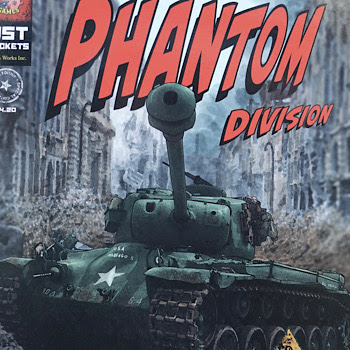
The recent release of Phantom Division from the Old School Tactical system, published by Flying Pig Games, is based around late war actions of 9th Armored and today we are looking at the ‘We Can Try’ scenario, which covers fighting near Remagen, Germany.


It is 7th March 1945. 9th Armored (Task Force Engemann)  is taking on an ad-hoc group of Volksturm and Luftwaffe units, in a scene that is a city fight, but with the Americans having to push through the town and exit the map at the other side, for the narrative goal of reaching the nearby Ludendorff Bridge. 


Rather than the usual city fight, that more usually is based upon capturing buildings, here, the American force needs to exit at least 7 units in 6 turns. Even though these late war U.S. forces out-class the defenders, this is a tough scenario for them and the German player is anything but passive.


The rest of this post gives way to a brief AAR that highlights some of the action and also the very nice boardgame components that this system offers. (Note there is a link to a shorter version of the replay in the Resource Section below).


Please use the ‘read more’ tab for the rest of this post’.


Friday, 1 January 2021

Old School Tactical - Noville, Belgium ‘44


In scenario 2 - ‘The Bigger They Come’, from the original OST Pocket Battles module, the opening background description tells of how Desobry’s men are preparing their defences, when they hear engines. This introduction concludes with the words “Moments later the first barrels poked through the mist. Tigers!”


And so the scene is set and from the outset we get a sense of drama, which this tactical WWII boardgame system is good at delivering. 


This post is just a run through of some of the mechanics of the system and the things making OST my ‘go to’ favourite at the moment.


For the rest of this post, please use the ‘read more’ tab.

Friday, 3 July 2020

Campaign files for the OST mini campaign.

Designed to work as a generic mini campaign with all of the map boards and various orders of battle, the test campaign for the east front game seemed to work pretty well and so this post introduces the download link to the Mini Campaign file (see the Resource Section below).

This is a fan based piece of work and is not officially endorsed by Flying Pig.

Tactical games by their nature end up with a lot of dice being thrown, so there are many opportunities for variables to kick in that might throw things off course, no doubt making some campaign games more or less successful than others, but in the main, I am at least hoping that a fair balance has been struck that will see most games give some fun play.
iPad doodle - 26 points worth of kit!

The mini campaign has been designed to initially identify an attacker, giving them a reason to capture objectives and to give them some additional resources to help do that, but importantly, from game two onward, the terms attacker / defender are deliberately dropped with those designations become blurred as both players may become engaged in attack and counter-attack opportunities. It is the desire to want this to happen that underpins the maths to help ensure that neither side is too over or under resourced.

The attackers do not get a huge starting advantage, certainly not the 3:1 type odds that might be expected, as a clear winner emerging in the first game would leave the other side always on the back foot and probably unable to recover. There are enough neutralising aspects here to prevent that.

Of course it is possible that if too many ‘calming’ influences come into play, the games could settle into just a ‘knock-about’ that doesn’t get us anywhere. I am hoping that the balance is close enough to being right and in any case, the processes involved are so transparent and stable, that if a player feels something needs tweaking, that can be easily done without breaking anything.

The campaign document has held up pretty well since the original draft in relation to the intention of how this should all work, but along the way, it got a few tweaks. Most notable was the way that players earned buying points in the Lull Phase.

Initially, this was based around the number of leaders that a side had and was capped at a certain level. In practice this did not work so well, as leaders fell to the high attrition rate. It was enough that the degree of leadership presence on the field, itself reflected in one side or the other having a leadership advantage in local situations during play, without then also feeding into the reinforcement rate.

So earning buying points has been changed to using the randomiser of 3D6 to provide a dynamic, but stabilised by a fixed addition of 15 points, with a guaranteed minimum of 22 points. It seems to work to give a tilt, without pushing one side or the other into a spiralling cycle of defeat.

Another change has been to drop the game length of each Action from 7 turns to 6 in order to reduce the amount of potential firepower and carnage over the course of the game, as the attrition rate was probably a tad higher than was good for the campaign.

There is the special rule that in the latter half of each game, based on a dice roll, things could end early, adding another dampening effect. The core OST system provides a natural counter to this with the rule that once a game reaches the last turn, players should test to see if the game is extended by 1 turn (i.e. turn zero on the countdown turn track), so a game may become lengthened or shortened.

A rule that allowed the Impulse Dice allowance to go up to 4D6 for the winner (based on casualties) of the previous Action was dropped as this tended to accelerate a decline in the losers fortunes too early.

Finally a few of the cost / buying allowances were tweaked, but by ever so small margins, that they hardly need mention here. 

The one thing that did get me thinking was that in the test game, that defending KV-1 was a nightmare to the opening attack, with its strong frontal armour, enhanced by tucking down behind a wall and then also gaining a ‘cover’ counter and I was left wondering whether the piece was too dominant without a counter-balance being available to the other side. 

However, if the Germans had drawn one or more 88mm Flak guns at the set up stage, which was fairly likely, then the KV may have been easily dealt with and the way ahead might have been quickly cleared in the first game, with that original German armoured force of 5 tanks and 2 halftracks then creating havoc, which may have brought its own imbalance, though certainly at least putting the focus on the subsequent fighting more towards the prime objective (the church) towards the rear of the defensive zone.

It is however the variable of whether such a thing will happen or not that seems the very essence of what a campaign game should deliver and for this system to ensure that there is enough variability that individual campaign games will potentially give differing routes of play. In any case, one might get something like the expensive 88mm gun and then lose it within minutes to an air or artillery strike, there are no guarantees.

Also, there are some other ‘in game’ ways of dealing with such a vehicle, such as causing damage to the main gun or track, getting into a flanking shot position, close assaulting it or getting an accurate artillery stonk. All these things may or may not happen, such are the variables that go with these things, but they do always add to a good story and bring game tension.

In the end, I decided to leave things the way they are and in this instance just enjoy the narrative of that ‘pill box’ type tank that held up an entire advance, which reflects historical accounts that I have read of similar experience. The campaign becomes more honest when sides have to deal with what they meet, with what they have.

It does of course show that the OST system nicely models the KV-1 in action in 1941-‘42. These sort of things are going to crop up in several settings.

(Panzers at War 1939-1942, Bob Carruthers, published Pen & Sword, pages 111 - 112. ‘Despite the fact that it [a 150mm howitzer battery] scored numerous direct hits from as close a range as 200 yards, its heavy shells were unable to put even a single tank [KV-1] out of action’.

‘To be sure, the engineers managed to get to the tank after midnight and laid the prescribed demolition charge under the caterpillar tracks. The charge went off according to plan, but was insufficient for the oversized tracks’). 

It is probably a bit of a tall order to expect the campaign document to work in every situation, but it should generally do okay and the player should feel free to make any in game adjustments that will get the campaign delivering the 'right feel' for them. 

Anyway, the mini campaign document is now available as a free fan based download in a PDF at the two links below (DropBox and Board Game Geek). 

Resource Section.
OST generic Mini Campaign download in PDF via DropBox, LINK

OST generic Mini Campaign download in PDF via Board Game Geek, LINK

Flying Pig game Company LINK

The opening blog post, which shows set-up and starts a campaign AAR. LINK


Wednesday, 1 July 2020

Part 4 (final) OST east front mini campaign

This post covers the fourth and final Action in our mini campaign. Following the Lull Phase after the third battle, both sides responding to their dire lack of infantry, released the last of their reserves.
KV-1 from my 15mm miniatures collection


Needing a counter-attack force to re-take the village, the Soviets received a company of ten rifle sections. The Germans, wanting to both keep hold of the village and try to exploit their right flank and reach the church beyond, received an under strength company of five rifles sections and an assault section - it seems they will have much to do!

If there was writing on the wall, it would likely say ‘Quantity has a quality of its own’! We shall see.

Please use the ‘read more’ tab to see how the campaign is unfolding.

Sunday, 28 June 2020

Part 3 OST east front mini campaign

This post covers the third of the four Actions in our mini campaign for the Old School Tactical system. Following the Lull Phase after the second battle, both sides have brought up some much needed infantry replacements, placing them across the whole front to try and cover losses, but in particular, supporting the centre, where the Soviet held village has seen much of the fighting.
The KV-1's crew are most unsettled by the repeated shell
strikes against their tank!


Please use the ‘read more’ tab to see how the campaign is unfolding.

Friday, 26 June 2020

Part 2 OST east front mini campaign

This post covers the second of the four Actions in our mini campaign. Following the Lull Phase after the first battle, the Soviets reinforced the village with infantry and sent a small tank detachment to firm up their left.
This is how we left game 1


For their part the Germans had brought up a couple of better armed tanks in an attempt to deal with the KV-1 menace.

Please use the ‘read more’ tab to see how the campaign is unfolding.

Monday, 22 June 2020

OST Campaign East Front 1942

I am putting together a mini campaign game for Old School Tactical, based around an ongoing battle that is split into four gaming sessions and uses an entire mapboard. Between each battle, there is a Resting Phase, which includes an opportunity to buy in some reinforcements.

The idea is that it will be generic enough to be usable with any of the core modules or the map boards in their associated expansions.


I am running through a campaign now to test the package and tighten any loose areas. My first draft already has quite a bit of the red e-ink all over it. Once done, I will put the file up for download.

This post covers the setting up and playing of the first of the four ‘Actions’ and shows a bit of buying activity taken in the subsequent Resting Phase.

Please use the ‘read more’ tab for the rest of this post.

Monday, 15 June 2020

Old School Tactical Vol III - Pacific

Old School Tactical is a boardgame series covering WWII warfare at the tactical level. One counter represents a single vehicle or weapon or a squad / section of infantry and the scale is 50 metres to the hex.

It is designed by Shayne Logan and published by Flying Pig.

Box art

It started with East Front 1941 - 42, then vol II covered North West Europe 1944 - ‘45 and now, with the third main module it has moved to the Pacific. There are also five supporting high quality modules that add to the base games. So all in all, this is a series game that is now really showing its credentials as being a significant player in the WWII tactical boardgame genre.

The rest of this post describes the new module and it’s associated expansion ‘Hell Bent’.

Please use the ‘read more’ tab to continue


Tuesday, 28 April 2020

The little Hetzer and the grizzled Sherman!

The German Hetzer is just one of those strange looking little vehicles that can easily become a wargaming favourite. With its very low profile, it was the perfect ambush vehicle.


This post is taking a single incident of a ‘hidden’ Hetzer ambushing a Sherman 76 and running through two rule sets to see how they model the relationship between these two very different vehicles.

Please use the ‘read more’ tab for the rest of this post.

Thursday, 14 November 2019

OST Stalingrad

Old School Tactical is the series title of a WWII tactical boardgame system that to date has core modules dealing with east Front 1941 - ‘42 and West Front 1944 - ‘45. Each core module has associated expansion modules and this post is based on the Stalingrad expansion, which has just come back into print.  


Designed by Shayne Logan and published by Flying Pig, the system is immediately identifiable by the large mounted game boards, large attractive game counters and a ruleset that is very accessible, especially considering how complex this genre can get.

With the Pacific core module on the horizon, I have been re-establishing my familiarity with the system and thought a post about the Stalingrad reprint worthwhile.

Please use the ‘read more’ tab for the rest of this post. 

Thursday, 11 April 2019

Platoon Commander KURSK

This is a WWII tactical game from Flying Pig Games. The core system is designed by Mark H. Walker and the Kursk module is designed by David K. Van Hoose.  The counters are platoons and ground scale is 150 metres to the hex.


An initial glance at the friendly sized components and the short rules, give a sense that this has been designed with a view to being very accessible and having relative ease of play, encouraging players to get what can typically be a complicated subject - armoured warfare, onto the table quickly.


As part of my streamlining of wargames, I bought it to compliment my more complex tactical games and to be the sort of thing that can come down off the shelf often for a face-to-face session. Can it be that game?


With the scenarios set in 1943 in the Kursk theatre of operations, there are a range of interesting actions and unit types. The expansion module (Tracks in the Mud) offers an additional map, some more units and six scenarios.


This post looks at the generalities of the system and will highlight some of the mechanics by playing going through the sequence of play for one turn. Tracks in the Mud is also discussed.


Please use the ‘read more’ tab for the rest of this post.

Thursday, 28 February 2019

Old School tactical - Tiger I v T-34 performance

Over time, this blog has looked at several tactical systems from the perspective of Gun / Penetration interpretation using these two vehicles as a benchmark and today we will be taking Old School Tactical (OST) for a spin. As per previous posts on the matter, I just like tactical games, I do not have particular knowledge of the subject, so treat this as a bit of fun, rather than something to hang your hat on.


OST is a tactical boardgame designed by Shane Logan and published by Flying Pig. Counters represent individual vehicles and squads and a hex is representing 50 metres, so this joins the popular ranks of Squad Leader, ASL, ATS, Band of Brothers, Lock ‘n Load Tactical, Conflict of Heroes and no doubt a bunch of others that I have missed. This article is exploring whether the Tiger and T-34 have an inter-play that delivers the ‘feel’ of what we might expect from combat accounts and testing ground experiences.


We will be looking at how the two vehicles compare and using the stereo-typed example of T-34’s ‘charging’ towards a Tiger to highlight rules and system mechanics. We will also be comparing the Tiger and Panther tanks, simply because it always interests me how designers approach the characteristics of these two similar (in game terms), but different (in real life roles) vehicles!

It is a lengthy post, so bring coffee and nibbles.


Please use the ‘read more’ tab for the rest of this post.